About Axiom Strategy Management
Axiom Strategy Management is a component of the Syntellis Axiom Healthcare Suite of financial solutions. The Axiom Healthcare Suite products support an iterative, continuous cycle in which strategic plans define day-to-day operational targets while operational data informs long-term strategic planning. Axiom Strategy Management supports this process by giving you the tools needed to monitor and manage how well your organization’s day-to-day activities align with its strategic plans, and the goals and processes that support them. Axiom Strategy Management enables you to translate strategy to execution in a measurable way, then feed those measurements back into the system to improve financial outcomes and overall organizational efficiency and productivity.
Understanding the Axiom Axiom Software system
Axiom Software products store your organization's data (financial data, labor data, key statistics, and so on), in a central database, and then pull that data into the interface where you can view, enter, or modify the data using familiar spreadsheet commands. Axiom Strategy Management also provides a spreadsheet-based interface from the Desktop Client General term for using either the Excel Client or the Windows Client, both of which are installed to the user's desktop., but except for a few administrative tasks, features and functions are accessed through the Web Client. The majority of this help site covers using Axiom Strategy Management in the Web Client.
Axiom Strategy Management basic components
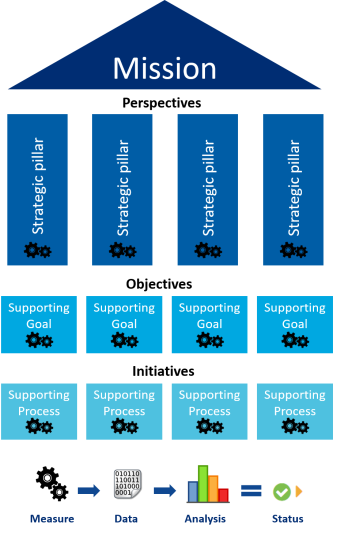
Axiom Strategy Management picks up where your mission statement leaves off. The system consists of three main levels: Perspectives, Objectives, and Initiatives. Each level in the strategy hierarchy is supported by the ones below it. The following graphic is simplified to illustrate the different levels, but in reality, Perspectives can have multiple Objectives, and Objectives can have multiple Initiatives. Measures are applied to each element at each level in the hierarchy, and so support the entire hierarchy.
|
Perspectives – Strategic pillars that uphold your organization’s mission. For example, if your organization is a hospital, one of your Perspectives might be Clinical Performance or Community Health Leader. Each Perspective has one or more associated Objectives. Objectives – Goals that support your organization’s Perspectives. Each Objective belongs to only one Perspective. Each Objective is associated with one or more Initiatives. Initiatives – Processes and procedures that employees perform to support the Objectives. Each Initiative belongs to only one Objective. Measures – Data collectors used to determine the performance status of the items to which they are applied. As illustrated by the process diagram at the bottom of the graphic, each measure collects data that the system uses to determine how well the strategy elements are performing. Based on this analysis, the system applies Key Performance Indicator icons to the elements to provide at-a-glance status updates. |
|
